The Transportation Research Board Annual Meeting 2025
On the Move: Highlights from the 104th Annual Meeting
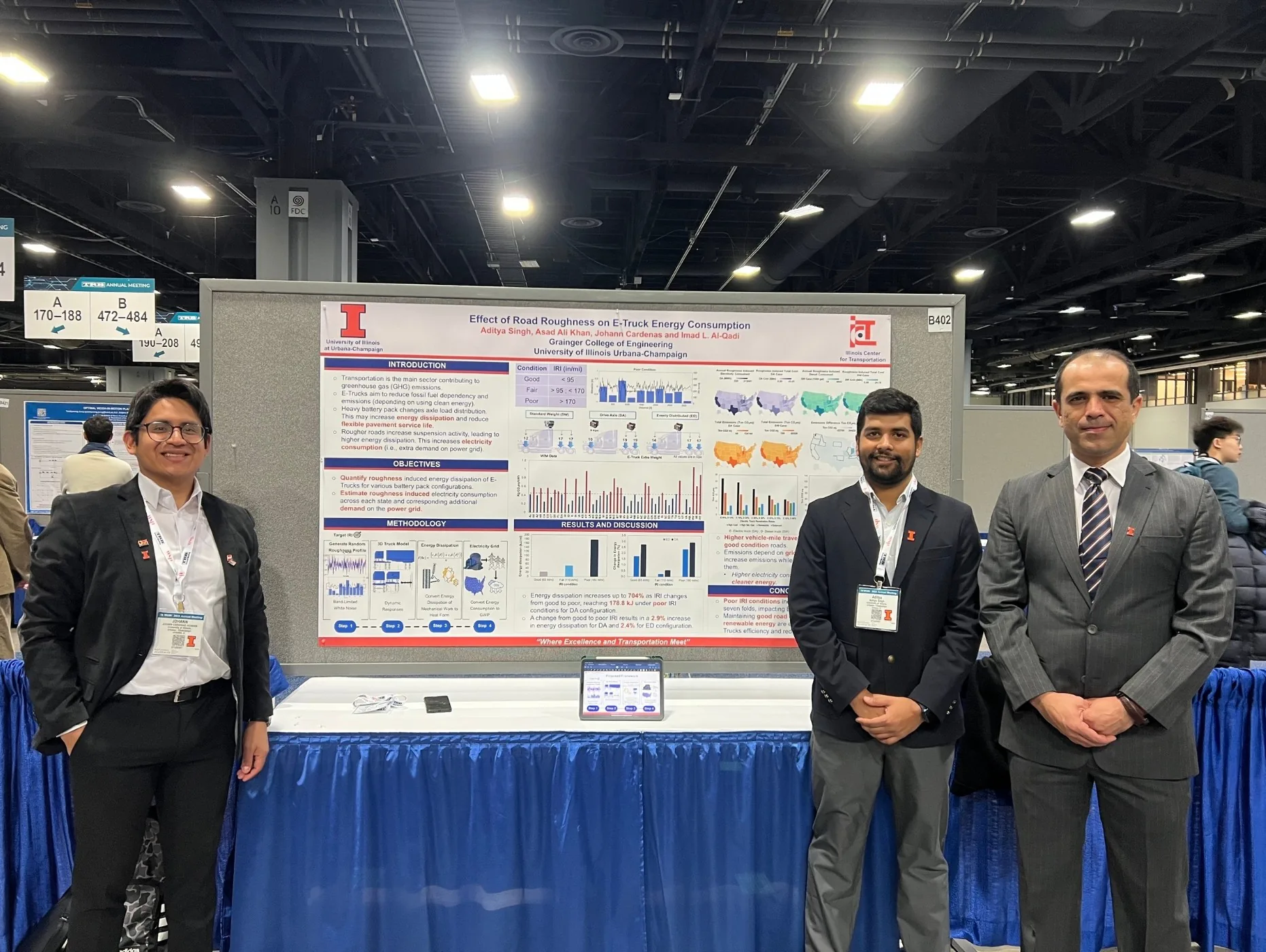
The Transportation Research Board (TRB) 104th Annual Meeting was held in Washington, D.C. from January 5-9, 2025. While I didn't first-authored any submission this year, I contributed to two submissions as a co-author. The first, was a lectern session presentation titled "Flexible Pavement Damage Quantification due to Heavy-Duty Electric Trucks", delivered by Angeli Jayme, as Principal Investigator of the R27-252:"Impact of Commercial Electric Vehicles on Flexible Pavement Performance" project. The second, was a poster presentation titled "Effect of Road Roughness on E-Truck Energy Consumption", presented by Aditya Singh. This was an independent work Aditya spearheaded, where he also included Asad Khan as co-author. Details can be found in Table 1.
| Description | Presentation | Authors | Date and Time |
|---|---|---|---|
|
Lectern Session From Top to Bottom: The Impact of Heavy Trucks Loads and Flexible Pavement Foundations 2137 |
Flexible Pavement Damage Quantification due to Heavy-Duty Electric Trucks | Angeli Jayme Johann Cardenas Jaime Hernandez Imad Al-Qadi |
Convention Center Monday, Jan 06 1:30 PM - 3:15 PM |
|
Poster Session Current Issues in Trucking Industry Research 4048-B414 |
Effect of Road Roughness on E-Truck Energy Consumption | Aditya Singh Asad Khan Johann Cardenas Imad Al-Qadi |
Convention Center, Hall A Wednesday, Jan 08 8:00 AM - 9:45 AM |
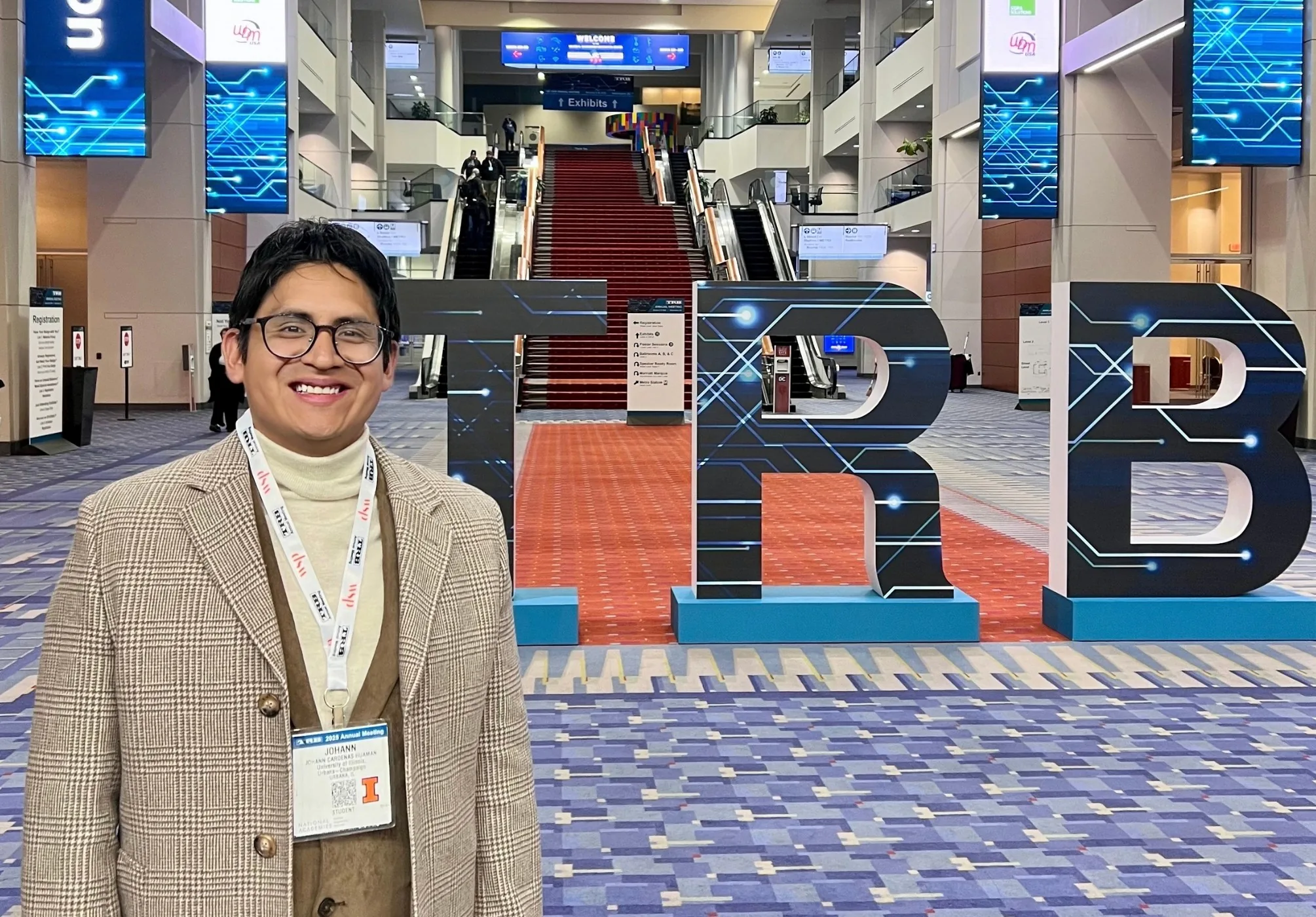
This was my 4th time walking into the heart of the Walter E. Washington Convention Center. With each TRB meeting, I become more intentional with my time there, seeking out specific workshops, lectern sessions, networking opportunities, and catching up with colleagues. TRB is truly a massive conference, with thousands of presentations, posters, and events happening simultaneously. I made sure to prioritize sessions that aligned with my research interests, particularly those related to numerical modeling, computational mechanics, pavement performance and the impact of emerging technologies. As usual we arrived on Saturday to the Embassy Suites Hotel, where most of us stayed, giving us time to settle in before the conference began on Sunday. On Saturday, we generally check in at the conference registration desk, pick up our badges and informational materials, and review the schedule for the week ahead. There is the annual APSE meeting on Saturday afternoon, that we generally attend as a group as Prof. Al-Qadi is one of the founding members.
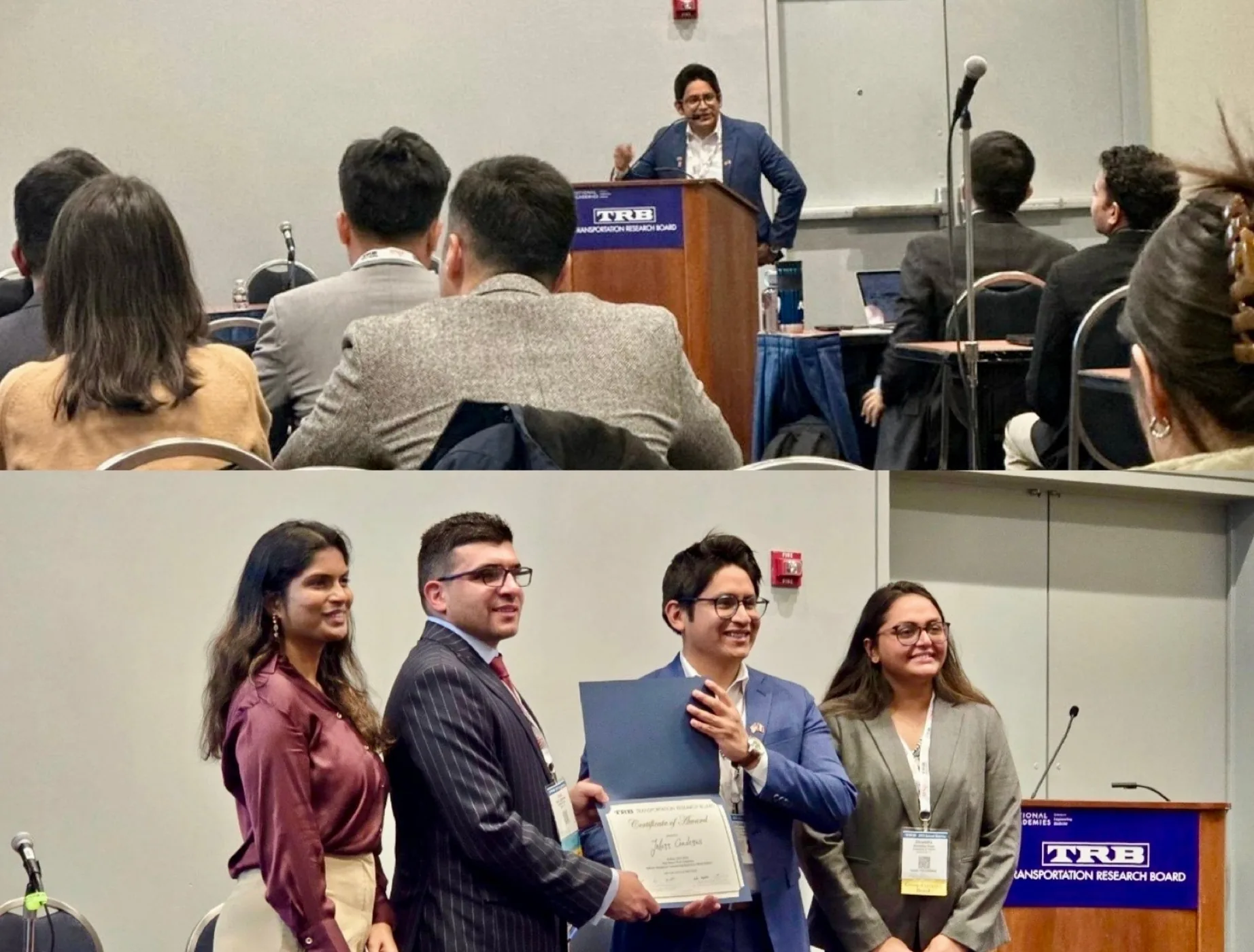
Earlier on Sunday, I participated in the Three-Minute Thesis (3MT) competitions. The 3MT competition is about showcasing your ongoing research in simple words. I chose to name my presentation "Rough Roads, Tough Loads: What's really breaking our pavements?". In this talk, my intention was to highlight that when we design asphalt pavements under the current guidelines, we ignore the compounding effect caused by road surface irregularities. The more uneven the surface, the more the vehicle bounces (e.g. when you hit a pothole) and therefore loads can be severely amplified by this bouncing (technically, we call this Dynamic Wheel Loading). If higher loads are applied to our pavements, the faster they will deteriorate so this effect should be incorporated into design. Now that electric trucks are about to be introduced, and they carry heavy batteries, loads will be by default higher than before, but could be even higher due to our pavement condition. I also discussed a bit the potential effects of aggresive acceleration/braking patterns on pavements, which is also likely to happen with the introduction of vehicles with higher torque availability. In that sense, some results from our ongoing research project IDOT R27-252 were briefly presented to prinpoint what we know so far about these effects. While I did not get to win the main prize, I was awarded the Audience Choice Award.
On Monday, Angeli presented the early findings of our work on the impact of heavy-duty electric trucks on flexible pavements during a lectern session. The audience showed great interest in the topic, especially considering the growing adoption of electric trucks in the transportation sector. Angeli did an excellent job explaining our methodology, which involved advanced finite element modeling to simulate pavement responses under electric truck loading scenarios. Later on Wednesday, Aditya presented our poster on the effect of road roughness on electric truck energy consumption. The poster session provided a more informal setting for discussion, allowing for in-depth conversations with attendees about our research methods and findings. Some students prefer poster sessions as they allow for more direct interaction and feedback from peers and experts in the field. I, myself, am the lectern session type of person, as I like to prepare and rehearse my presentations well in advance. Asad and I were there to support Aditya during his presentation, and captured some photos of the session (Fig 3).
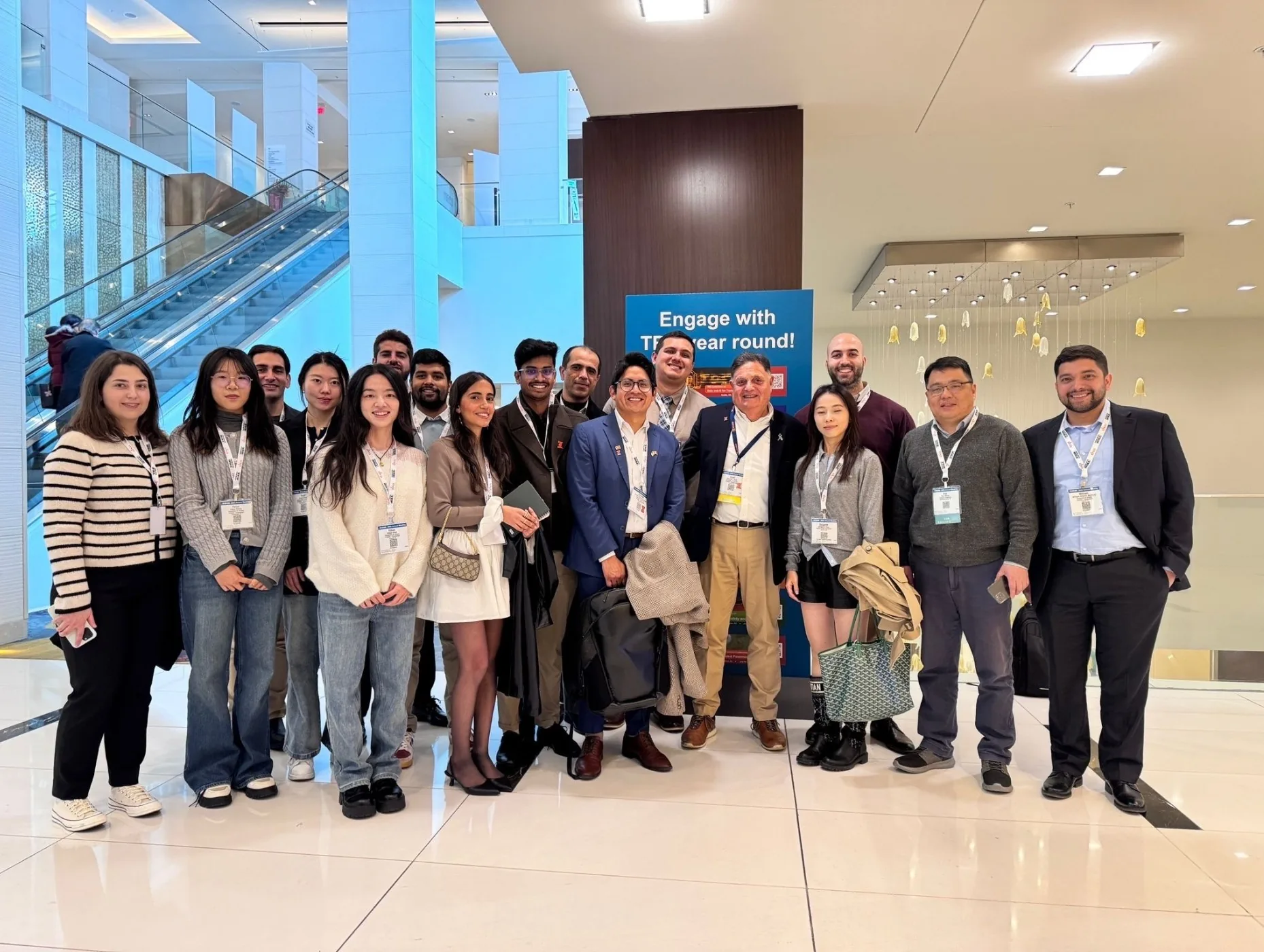
Students, alumni (some now faculty members), and professionals representing ICT and Illinois got together for a group photo at TRB 2025 (Fig 4). It is always great to see familiar faces and connect with the broader ICT community at these events. In this picture, from left to right, we have: Mahsa Tofhighian, Feiyu Huang, Egemen Okte, Yudi Wang, Yihan Chen, Babak Asadi, Aditya Singh, Lara Diab, Namith Gangidi, Asad Khan, me (Johann Cardenas), Alex Sandoval, Prof. Al-Qadi, Qingwen Zhou, Mohammad Fakhredinne, Hao Wang, and William Villamil. When I arrived at ICT in 2021, Qingwen and Egemen were already there as senior PhD students, and they are now faculty members at Wayne University and UMass Amherst, respectively. Hao is a Professor at Rutgers University, and one of the persons I probably cite the most in my research, as he was involved in spearheading some of the earliest research on flexible pavement numerical modeling. I guess some of the new students already look at me as a senior member of the group now!