Mechanistic Overload Permitting Approach for Flexible Airfield Pavements via Deterministic Damage Factors
Mentor: Imad L. Al-Qadi
This study is being conducted as part of the Transportation Research Board's Airport Cooperative Research Program (ACRP), and is expected to be completed by July 2026. The final research paper will be presented at the TRB Annual Meeting in January 2027.
Please see the official announcement here:
Problem Statement
The Aircraft Classification Rating-Pavement Classification Rating (ACR-PCR) system adopted by the Federal Aviation Administration (FAA) in Advisory Circular 150/5335-5D (FAA,2022) provides airport operators with a single pavement-strength number and an empirical rule that allows occasional overload traffic of aircraft whose ACR exceeds the estimated PCR so long as such cases remain below 10% over the rating and constitute no more than 5% of annual departures. However, the Circular itself acknolewdges that this system is only intended for reporting pavement strength and is not a design or life-prediction procedure.
Atlhough the ACR-PCR framework represents a clear advance over the previous ACN-PCN system (Senseney & Sagisi, 2023), there are still critical gaps to be addressed. Moder wide-body aircraft operate with tire inflation pressures near 250 psi and freature compelx landing-gear configurations that produce highly non-uniform vertical and tangential tire-pavement contact stresses, while many general-aviation runways consist of thin asphalt surfaces that can reach temperatures as high as 131°F (55°C) during summer. Past research has shown that such conditions amplify rutting and shear strains beyond those predicted by simplified closed-formed solutions (Gamez et al., 2018; Hernandez & Al-Qadi, 2015; Khresat et al., 2025). Additionally, full-scale studies have evidenced that while thin and softend asphalt layers can deteriorate after a few oveerload passes, thick, polymer-modified surfaces at large hubs could safely accomodate more passes than the aforementioned 5% rule (Alves & Fontul, 2024; Brill, 2023).
Recent evaluations of the ACR-PCR system have reported inconsistencies between the PCR and measured field performance, where cross-sections with identical PCR experience different asphalt-related damage as the PCR does not capture site-specific conditions, which calls for a mechanistic overload check (Armeni & Loizos, 2022; De Castro & De Oliveira, 2024; Sun et al., 2025). The FAA's own Strategic Outlook for Pavement Research places allowable overload determination among its highest near-term priorities. Yet, no framework currently links approvals to actual damage progression in asphalt runways. The present overload allowance could be potentially unsafe for marginal runways and economically restrictive for robust ones that could benefit from a deterministic decision-making approach.
Research Objective
The objective is to supplemtn the existing ACR-PCR 5%-10% rule by developing a preliminary mechanistic framework where incremental structural damage caused by each overload departure could be quantified and translated into a reliable allowance policy for flexible runway pavements. This framework aims to help justify stricter or looser limits for overload permitting using site-specific conditions (per runway, per season allowance). The study will:
- Generate accurate three-dimensional (3-D) aircraft tire-pavement contact stress distributions for a critical wide-body aircraft.
- Compute time-dependent airfield pavement responses for a selected set of temperatures and structural configurations, using 3-D finite element modeling.
- Develop an operational screening framework that determines how many overload departures a runway can safely handle based on its remaining structural life.
Scope and Limitations
This study focuses on flexible runways pavement and will use a prametric matrix of representative average and extreme pavement temperatures. The analysis will combine 3-D finite element (FE) modeling with existing mechanistic-empirical damage models. Because the available data are insufficient to develop and calibrate a full aircraft model, the FE component will use a simplified tire representation that still captures the effect of tread and rib imprint geometry, tire inflation pressure, and load magnitude on the contact stress distribution. The flexible pavement FE model will be restricted to simulating a single pass of the governing 1D, 2D, or 3D gear configuration for each selected aircraft. While the study will revise existing large-scale performance data to evaluate the transfer functions embedded in FAARFIELD, it will not seek to recalibrate or develop new transfer functions. The study will focus on assessing regional airports as these could be susceptible to early deterioration due to disproportionate damage caused from occasional wide-body aircraft landing/take-off. The primary outcome will be the estimated allowable number of overload passes before the flexible pavement reaches the end of its service life.
Methodology
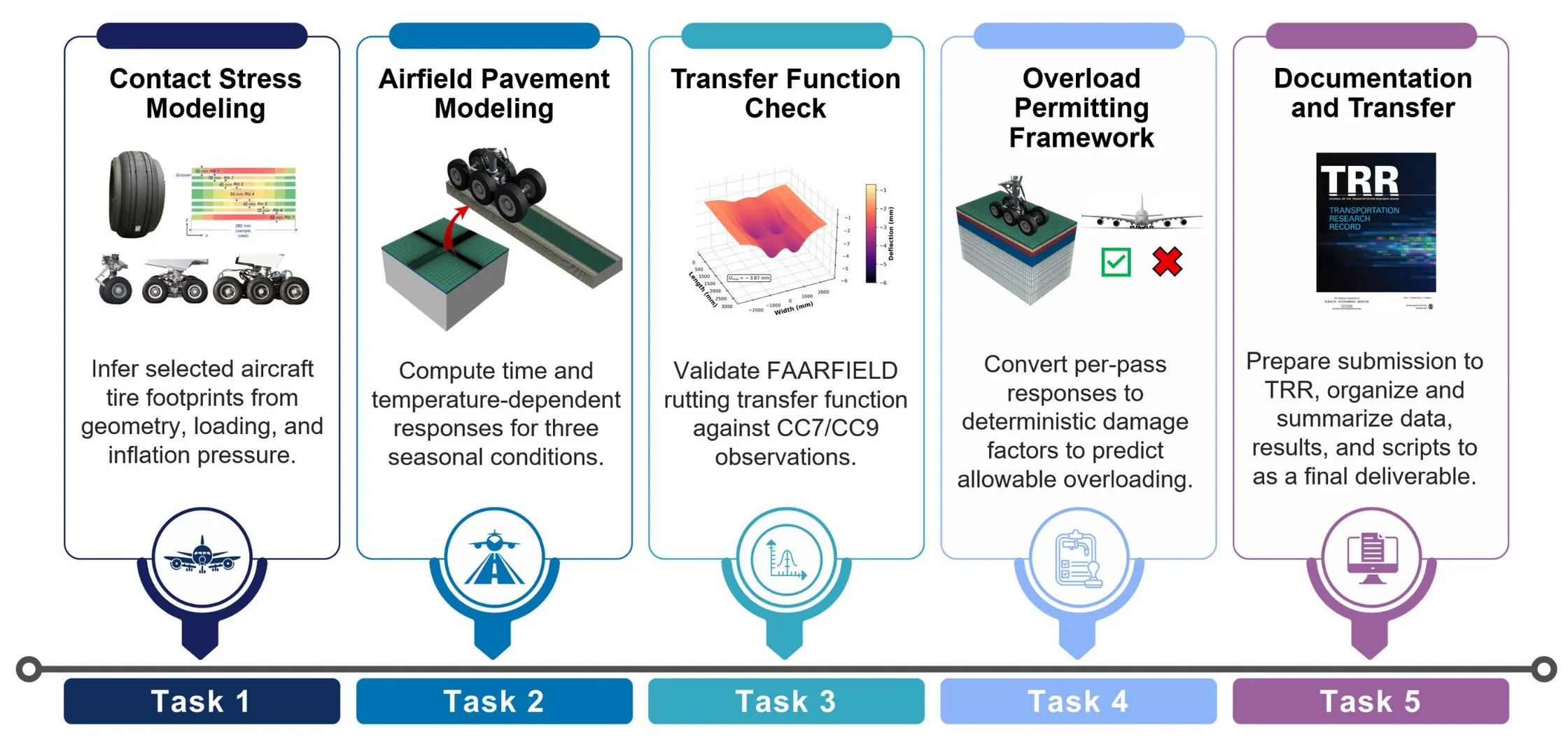
The research proposal will be divided into five sequenced tasks (see Figure 1):
- Tire Contact Stress Modeling: Information will be collected to capture the tire imprint and contact stress distribution of selected aircraft.
- Airfield Pavement Modeling: Predicted 3-D contact stresses will serve as loading inputs to predict the response of a validated 3-D FE airfield pavement model.
- Transfer Function Check: The performance of existing rutting and fatigue transfer functions as implemented in FAARFIELD will be evaluated based on the overload testing conducted at NAPTF.
- Overload Permitting Framework: Transfer functions will be used along FE critical responses to estimate the maximum number of allowable overload departures X for a user-selected life-consumption limit or the maximum permitted take-off weight for a single overload case.
- Documentation and Technology Transfer: Deliverables will include a technical report, contact stress dataset, airfield pavement responses dataset, and source code to automate processing tasks.
- Alves, T., & Fontul, S. (2024). Airport Pavement Structural Evaluation: The New ACR-PCR Method Applied to Existing Runway Pavements. In P. Pereira & J. Pais (Eds.), Proceedings of the 10th International Conference on Maintenance and Rehabilitation of Pavements (Vol. 523, pp. 233–243). Springer Nature Switzerland. https://doi.org/10.1007/978-3-031-63584-7_24
- Armeni, A., & Loizos, A. (2022). Preliminary evaluation of the ACR-PCR system for reporting the bearing capacity of flexible airfield pavements. Transportation Engineering, 8, 100117. https://doi.org/10.1016/j.treng.2022.100117
- Brill, D. (2023). PCN-PCR Comparisons for Medium- and Large-Hub Airport Runways (Final Report No. DOT/FAA/TC-23/57; p. 112). U.S. Department of Transportation Federal Aviation Administration Airport Technology R&D Branch William J. Hughes Technical Center. actlibrary.tc.faa.gov
- De Castro, C. C. O., & De Oliveira, F. H. L. (2024). Effect of Replacing Resistance Classification Methods for Flexible Airport Pavements. Journal of Transportation Engineering, Part B: Pavements, 150(3), 05024002. https://doi.org/10.1061/JPEODX.PVENG-1314
- FAA. (2022). AC 150/5335-5D Standardized Method of Reporting Airport Pavement Strength—PCR. U.S. Department of Transportation Federal Aviation Administration.
- Gamez, A., Hernandez, J. A., & Al-Qadi, I. L. (2018). Development of Domain Analysis to Predict Multi-Axial Flexible Airfield Pavement Responses Due to Gear and Environmental Loadings. Transportation Research Record: Journal of the Transportation Research Board, 2672(40), 326–335. https://doi.org/10.1177/0361198118758025
- Garg, N., Bhasin, A., & Vandenbossche, J. M. (Eds.). (2023). Airfield and Highway Pavements 2023: Selected papers from the International Airfield and Highway Pavements Conference 2023: Austin, Texas, USA, 14-17 June 2023. Volume 1: Design, construction, condition evaluation, and management of pavements. International Airfield and Highway Pavements Conference, Red Hook, NY. Curran Associates, Inc.
- Hernandez, J. A., & Al-Qadi, I. L. (2015). Airfield Pavement Response Caused by Heavy Aircraft Takeoff: Advanced Modeling for Consideration of Wheel Interaction. Transportation Research Record: Journal of the Transportation Research Board, 2471(1), 40–47. https://doi.org/10.3141/2471-06
- Khresat, G. A., Darabi, M. K., & Little, D. N. (2025). Rutting performance prediction of flexible airfield pavements using nonlinear mechanistic models for asphalt and granular layers. Transportation Geotechnics, 52, 101575. https://doi.org/10.1016/j.trgeo.2025.101575
- Senseney, C. T., & Sagisi, E. R. (2023). A Correlation Between ACN and ACR for the C-17 Aircraft on Flexible Pavement in the ACN-PCN and ACR-PCR Airport Pavement Rating Systems. Selected Papers from the International Airfield and Highway Pavements Conference 2023, Volume 1: Design, construction, condition evaluation, and management of pavements.
- Sun, J., Oh, E., Chai, G., Ma, Z., & Bell, P. (2025). Comparison between ACN–PCN and ACR–PCR for rigid airport pavement with case study. Road Materials and Pavement Design, 26(3), 720–732. https://doi.org/10.1080/14680629.2024.2375604
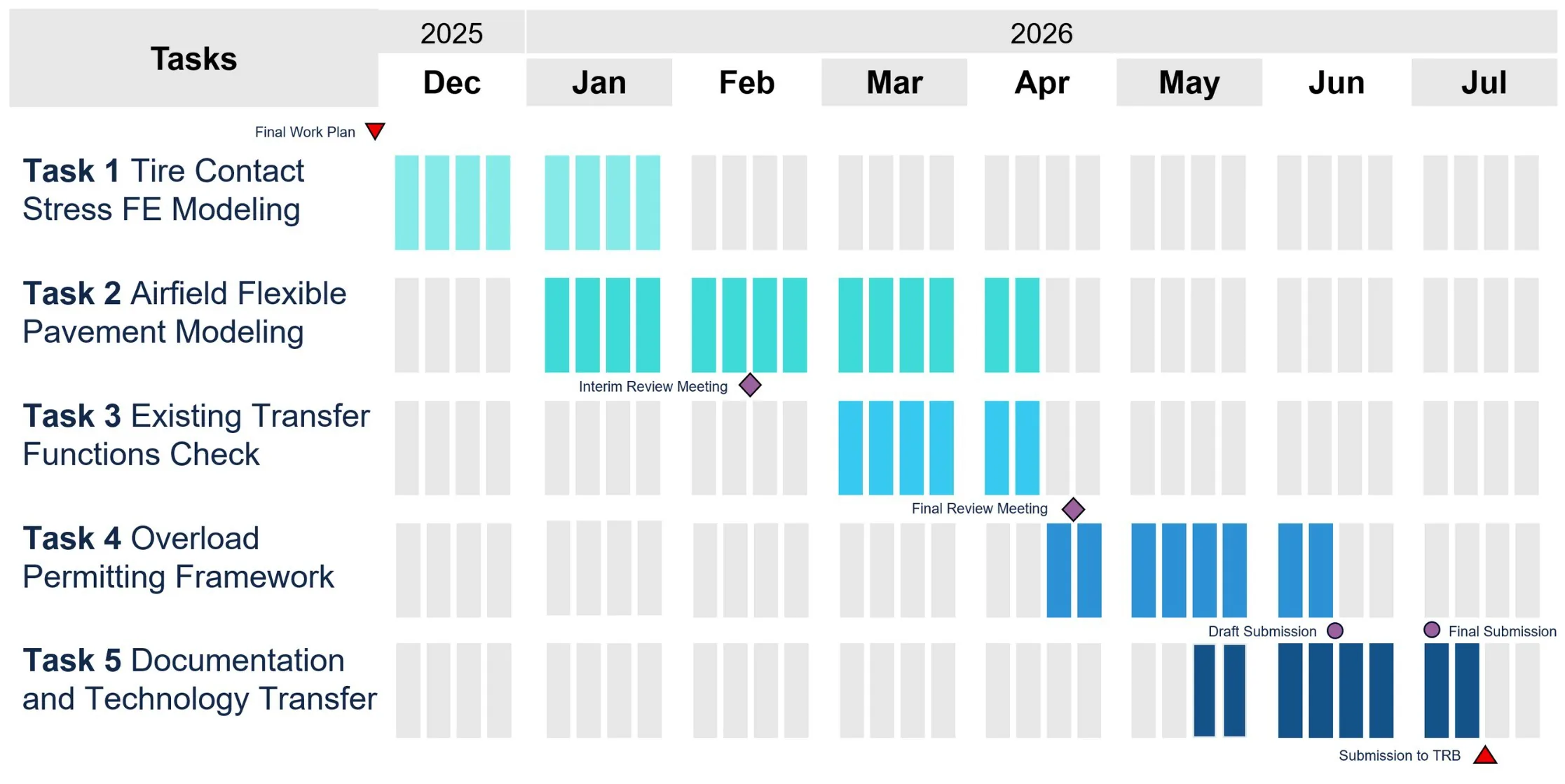
All project tasks are scheduled for completion within the award period, culminating in a full paper for TRB submission by mid July 2026 and, pending acceptance, presentation at the 2027 TRB Annual Meeting. Intermediate deliverables include a draft final paper submitted to the review panel by mid June 2026 and a revised paper by early July 2026. A detailed workplan scheduled is shown in Figure 2.
Expected Outcomes and Impact to the Aviation Industry
The study will provide a preliminary mechanistic approach for evaluating occasional overload operations on asphalt runways, enabling airport operators to issue overload approvals based on real-site specific climate conditions and structural capacity, rather than a fixed empirical share of traffic. Thin pavements operating at high temperatues could be protected through stricter overload limits to prevent early deterioration, while stronger polymer-modified surfaces at large hubs could safely accomodate additional heavy passes without premature damage, improving economic performance.
This framework will supplement the ACR-PCR methodology, introduced by the International Civil Aviation Organization (ICAO) and adopted by the Federal Aviation Administration (FAA). The ACR-PCR system became fully applicable on November 28, 2024, as the standard reporting method, although the FAA has extended the PCR reporting deadline for runways at Part 139 certificated airports to November 28, 2025. The proposed overload method will provide a mechanistic bases for interpreting PCR values. Airport operators are familiar with the legacy ACN-PCN method, and several studies have attempted to relate ACN-PCN to the newer ACR-PCR system, despite the lack of a direct mathematical correlation between these two methods. The main potential beneficiaries are medium-hub and non-hub airports. These airports could avoid early deterioration from occasional wide-body aicraft operations, by setting runway and season-specific overload caps, thereby deferring costly overlays and uplanned closures. Aircraft manufacturers will benefit from a mechanics-based weight-approval criterion, while the academia and airfield pavement engineers will gain access to an open dataset of high-pressure aircraft tire contact stresses for future studies. Overall, this study will contribute to move FAA overload assessment toward closer alignment with the mechanistic principles already embedded in its pavement thickness design methodology, helping advance the Next Generation FAARFIELD objectives.