ICT R27-203: Building Machine-Learning-Based Prediction Models for Computationally Efficient Airfield Pavement Analysis
Principal Investigator: Imad L. Al-Qadi
ICT R27-203 was conducted in cooperation with the Illinois Center for Transportation (ICT), and the U.S. Department of Transportation, Federal Aviation Administration (FAA). The final technical report of the project is still under review by the FAA and is expected to be published soon. The content below is based on such report. Please reference as follows if you wish to cite this work:
Project Objectives
To address the limitations of current airfield pavement analysis tools, this project aimed to leverage advanced numerical modeling and physics-informed machine learning (PIML) techniques. It specifically focused on using graph neural networks (GNNs), chose for their structural similarity to the finite element (FE) mesh, to predict airfield pavement structural responses. The objectives include the following:
- Developing a tailored 3-D FE airfield pavement model that incorporates the complexities of heavy aircraft tire-airfield pavement interaction and validating the model's predictions using results from accelerated pavement testing (APT).
- Creating a unified dataset for flexible airfield pavement responses by conducting FE simulations for selected cases to assess the influence of parameters such as layer thickness, material characterization, gear configuration, and load magnitude on critical responses.
- Developing a GNN-based PIML model to predict full-scale highway pavement structural responses using the response data from 3-D highway pavement FE analyses.
- Developing a model to predict structural responses of airfield pavements, combining the numerical matrix results from airfield pavement cases with transfer learning from the highway pavement PIML model.
Practical Value
Accurate response prediction is not restricted to academic purposes in airfield engineering as it directly supports decisions on layer thickness, material selection, and performance expectations under evolving aircraft fleets. The FAA design process depends on critical responses as inputs, and when such responses are biased, the design could risk early distress and increased maintenance costs or lead to greater upfront construction costs due to overdesign. Additionally, improved response prediction is valuable for interpreting large-scale test results and extend such results beyond the specific sections and loading cases tested.
From the perspective of a practitioner, the goal is not to replace FAARFIELD with a sophisticated FE modeling workflow for every project. FAARFIELD is effective because it is efficient and standardized for pavement design. The pratical path is to use validated numerical modeling to strengthen simplified analytical methodologies and then embed it into the existing design workflow through either calibrated adjustment factors, response libraries, or reduced-order models that preserve mechanistic prediction while remaining fast enough for routine iterative use.
In that sense, advanced FE modeling is proposed as the backend engine of existing airfield flexible pavement design tools to i) improve reliability in response prediction for new gear types and higher tire inflation pressures, ii) guide calibration of response-based distress models, and iii) support integration strategies where mechanistic results inform existing FAA platforms instead of competing with them.
Methodology
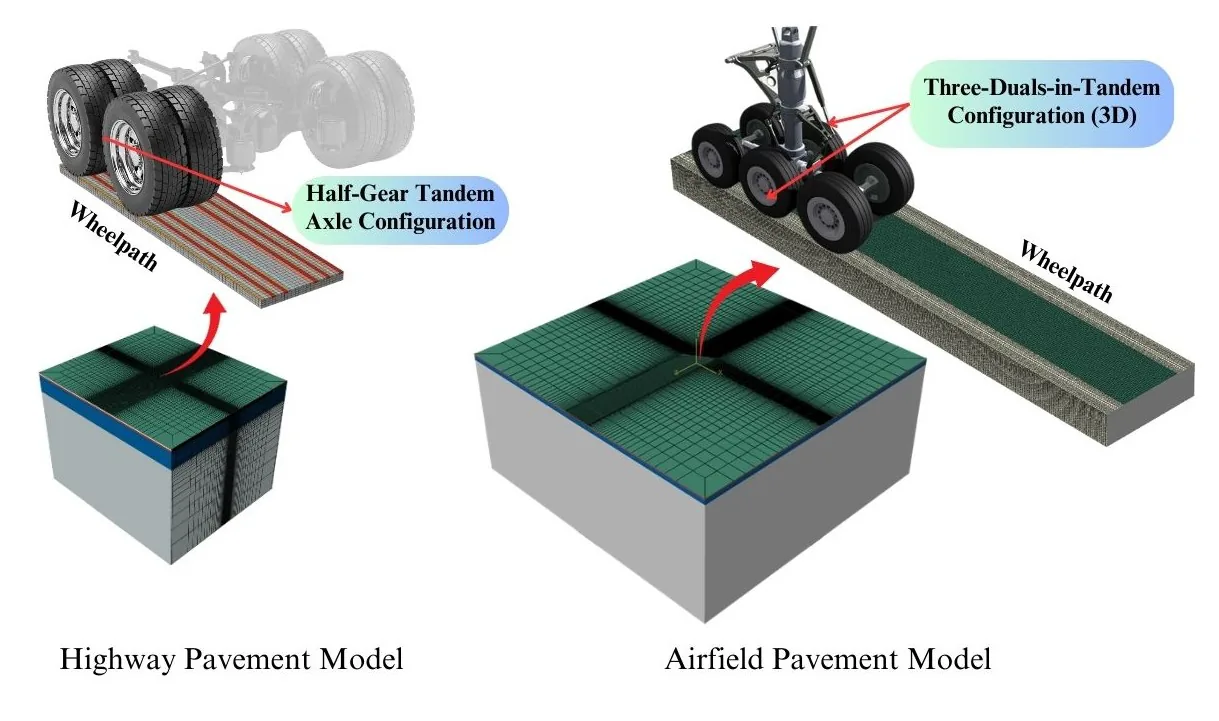
The research team adapted a previously validated FE model, originally designed for highway pavements, to account for the unique loading patterns aircraft impose on airfield pavements (see Figure 1). However, expanding the model to cover larger analysis domains significantly increased runtimes, especially for 3D configurations under full-gear loading, rendering them impractical.
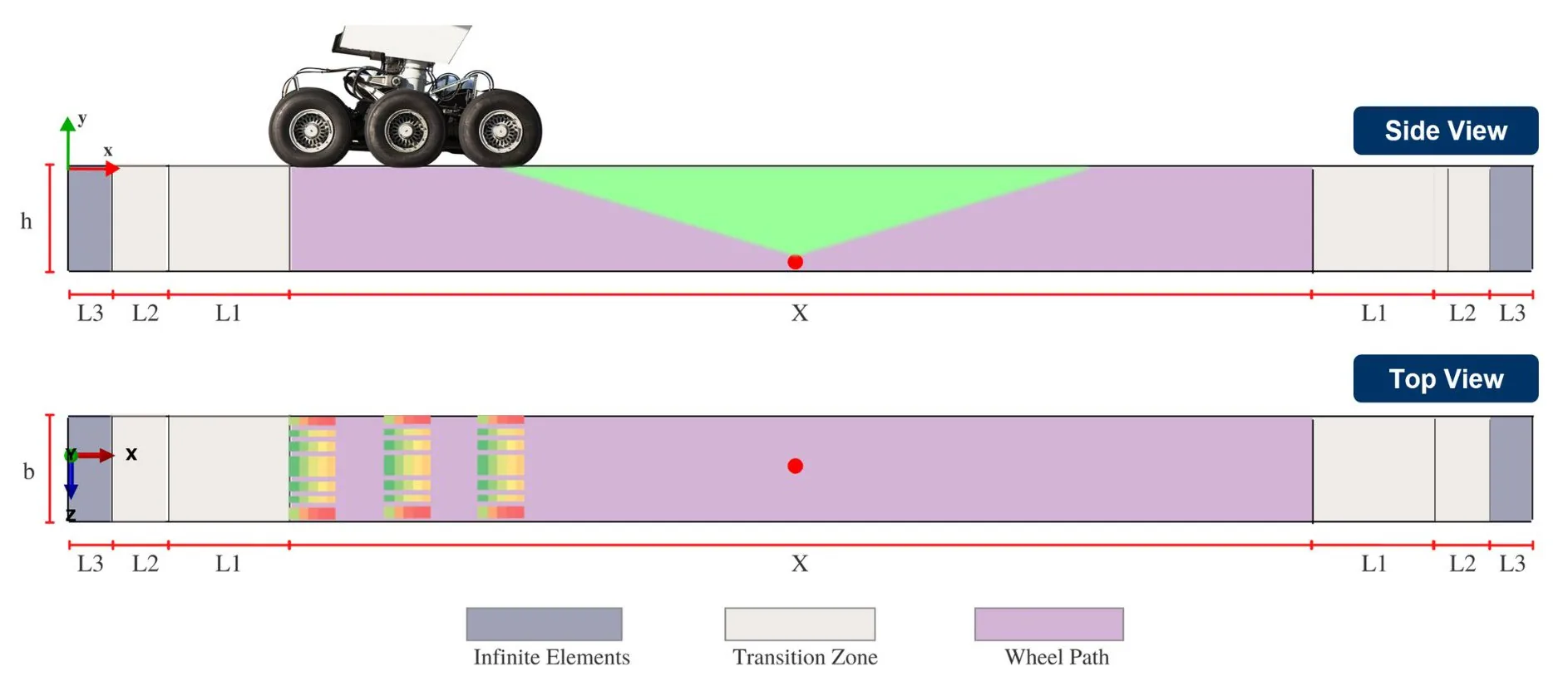
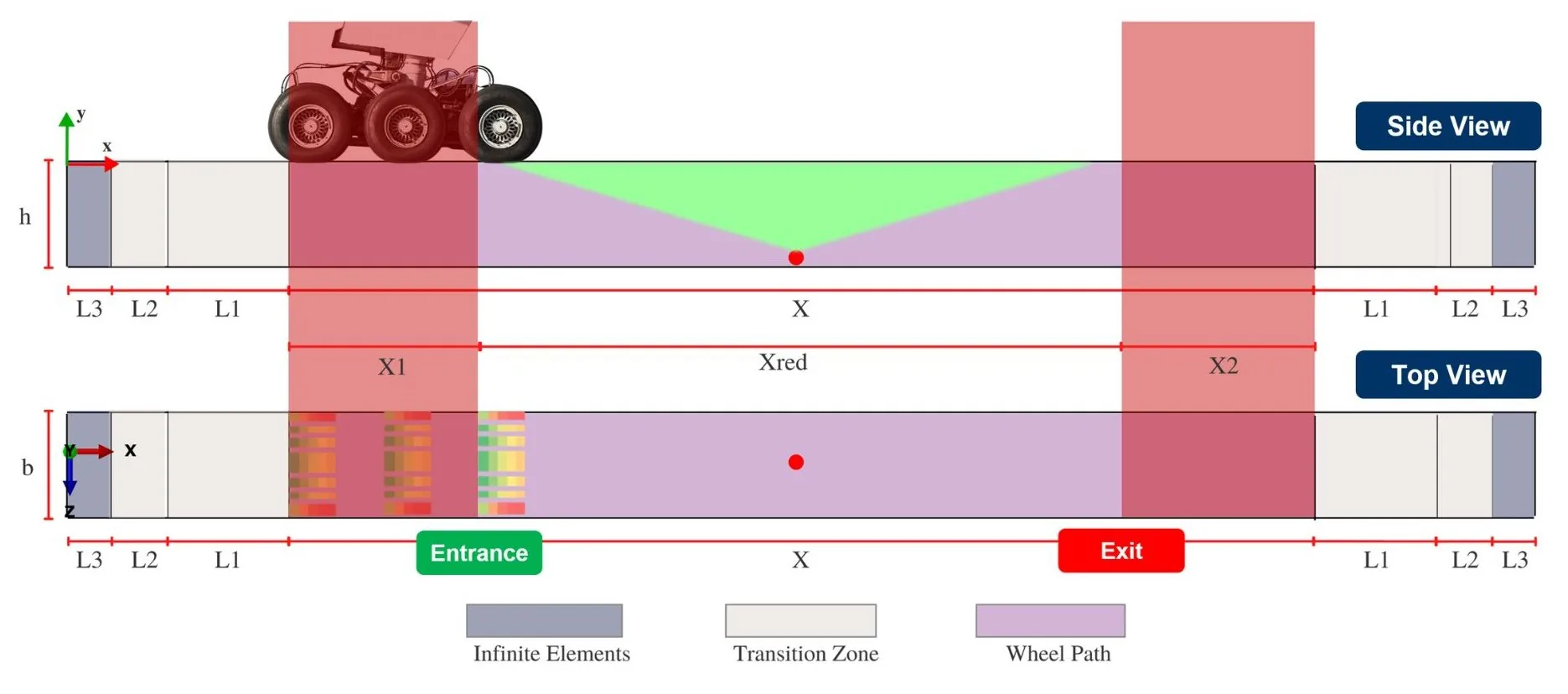
To address the runtime issues, a new loading approach, namely Load Pass Approach (LPA) was developed, and effectively reduced the size of the analysis domain (see Figure 2 and Figure 3). This approach significantly decreased runtime without compromising the accuracy of the predictions. The airfield pavement model was further validated using the results of large-scale testing provided by the FAA. Specifically, the data from Construction Cycle 7, including the instrumentation response, pavement section geometry, material characterization, tire inflation pressure, and loading configurations were used for the validation process and for designing the numerical matrix.
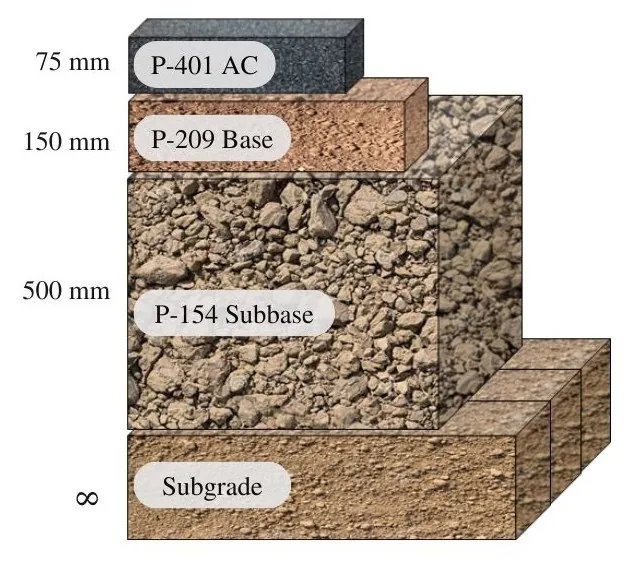
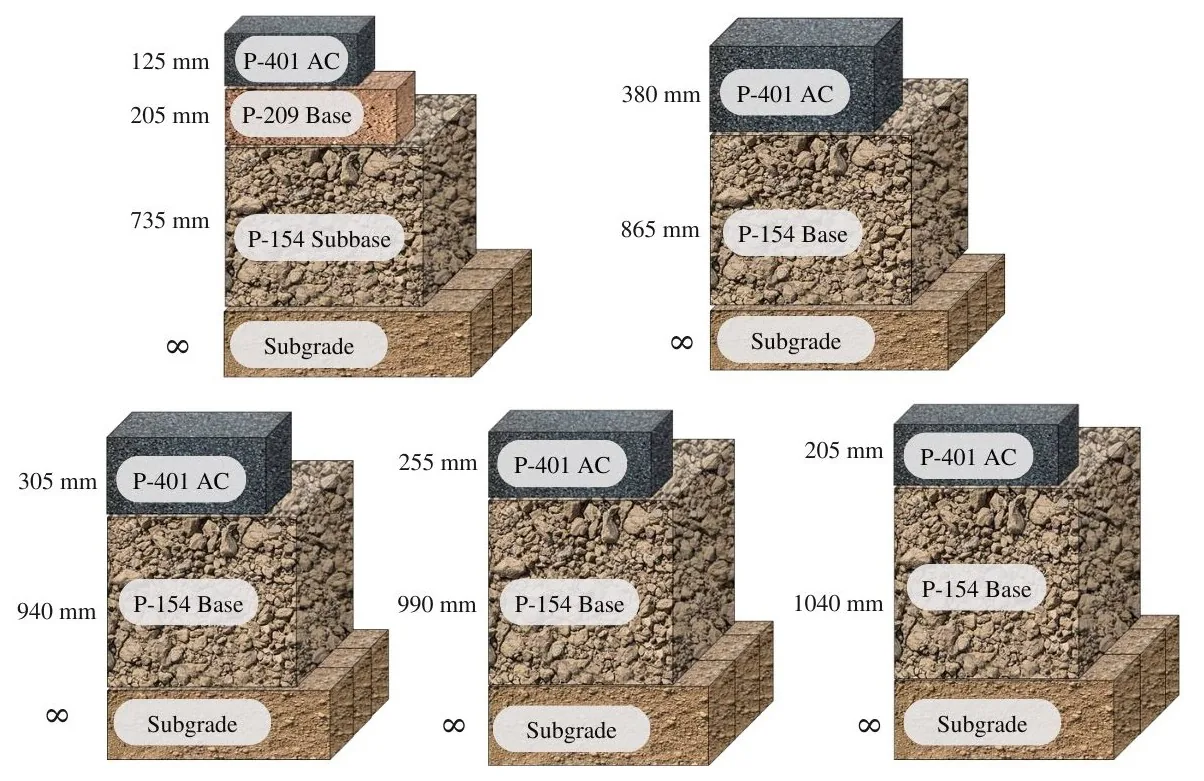
Despite the benefits of incorporating the LPA, conducting airfield pavement simulations was still computationally demanding, limiting the study to a selection of 23 cases. The cases could be categorized by the axle configuration, including eight D, eight 2D and seve 3D gear configuration cases. Of these, 18 cases used the configuration of the South Section (see Figure 4), allowing the analysis of parameters such as axle loading, asphalt concrete (AC) characterization, and axle configuration. The remaning five cases used different configurations tested in the North Section (see Figure 5), facilitating the isolation of layer thickness effects on airfield pavement responses. Strain, stress, and displacement data were extracted for every node within the model at each timestep, creating an extensive dataset. This allows for outputs to be accessed from any location within the pavement domain.
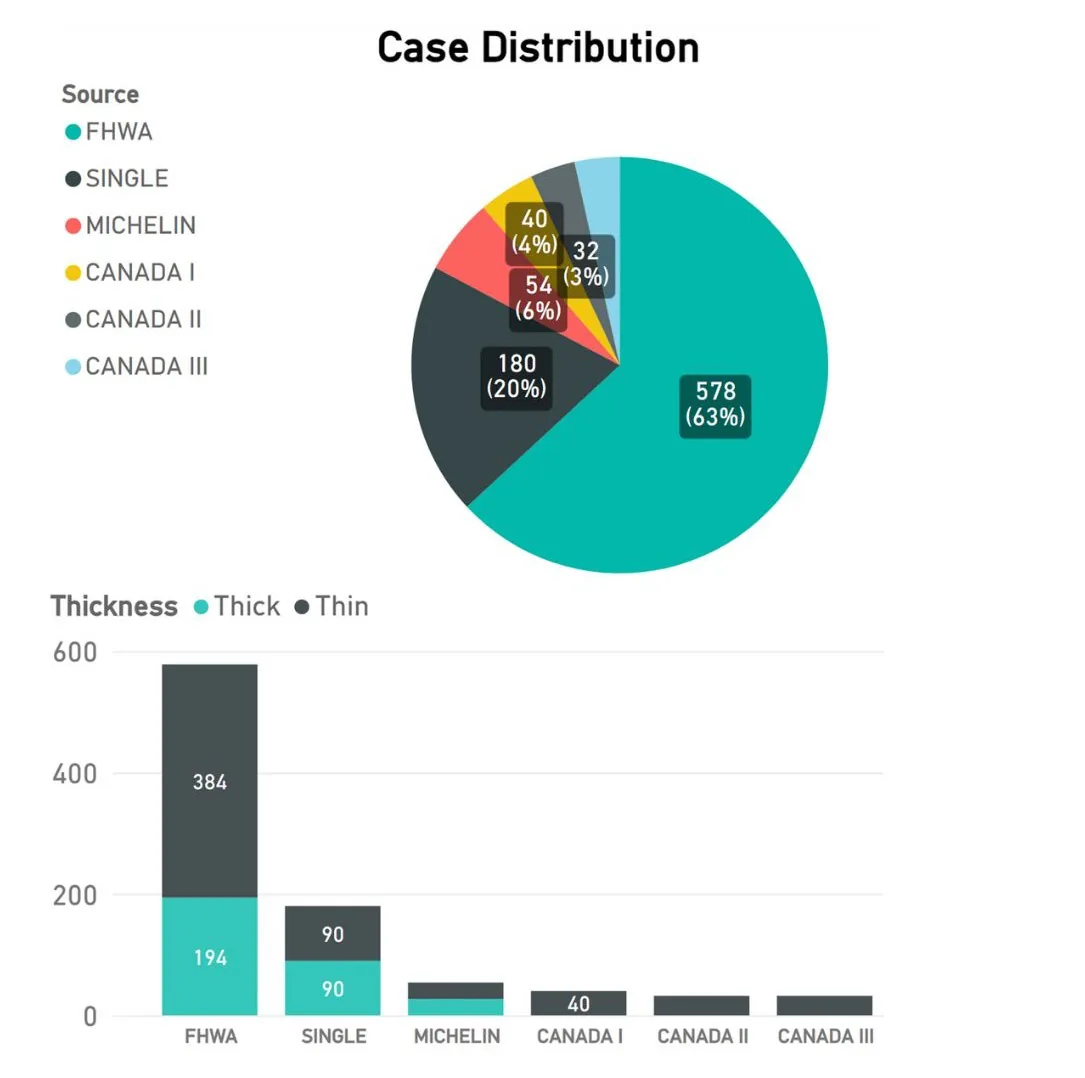
Although the cases selected yielded rich datasets, the number of simulations was insufficient to ensure robust predictions in data-driven models. To overcome this limitation, the research team leveraged the benefits of transfer learning. Despite the differences in domain size and loading configurations between the highway and airfield pavement models, it was assumed that the interaction among factors and the response distribution patterns were similar. Consequently, insights obtained from highway pavement simulations could enhance the accuracy of predictions for airfield pavement scenarios, given thelimited size of the airfield case datasets. Initially, a database was established (see Figure 6), collecting 3-D FE simulations of flexible highway pavements from the Illinois Center for Transportation (ICT) spannig the past two decades. This databse provided a useful baseline for the graph neural network (GNN), documenting structural responses such as stress, strain, and displacement across various loading phases and locations within varying pavement structures. These responses were influenced by many factors, including loading conditions, the tire-pavement contact, pavement layer configuration, material characterization, and environmental variables such as temperature.
Building upon the highway pavement FE database, a GNN was constructed to predict the highway pavement structural response at each loading step. Unlike traditional data-driven models, this GNN uses a graph representation of pavement FE nodes, merging physics-based insights into the ML framework. The model enable the simulation of structural behavior under continuous tire loading, maintaining high accuracy while avoiding substantial increase in computational time. Recognizing the similarities between highway and airfield pavements, the GNN model, having been pre-trained on highway pavement datasets, was subsequently adapted to predict structural responses for airfield pavements under varied loading scenarios (D and 3D gear loading) via transfer learning. A selected number of 16 simulations conducted using the airfield pavement FE model was used to train the GNN model, while seven simulations were used for testing.
Findings
The key findings of this project are:
- Full gear loading configurations, including D, 2D or 3D, are essential ofr accurate 3-D FE analysis of airfield pavement structures, given the importance of aircraft gear dual spacing as a model feature.
- Axel magnitude was found to be the governing factor affecting critical responses.
- The critical tensile strain at the bottom of the AC layer can be found either in the longitudinal and the transverse directions, so both must be verified.
- The runtime of airfield pavement simulations can be significantly reduced by using the Load Pass Approach (LPA).
- The assembly of 817 flexible highway pavement 3-D FE simulations into a database enabled a visualization of tire-pavement interactions and the varying structural responses at different loading steps and structural depths.
- The GNN model demonstrated an advantage over traditional data-drive models by effectively using a graph representation of pavement finite element (FE nodes).
- The message-passing component of the pre-trained GNN model was used and kept static during training because its function closely mirrors the mechanistic analysis integral to FE analysis.
- To manage the larger graph sizes associated with airfield pavements, two model adaptation strategies were investigated: model scaling and graph pooling. Both models achieved acceptable testing errors.
- While the model scaling approach may lead to higher prediction errors in the base layer due to overfitting, the graph pooling approach tends to introduce greater errors in the subbase and subgrade layers.
Conclusions
The major conclusions of this project are as follows:
- Analysis and visualization of FAA NAPTF data for construction cycles 1, 3, 5, and 7 provided insights into the behavior of pavement structures under aircraft loading.
- Despite the additional complexities of airfield pavements, the relationship between load, thickness, material properties, and critical responses followed a similar patter as those of highway pavements.
- Overlooking the complexities of the aircraft-airfield pavement interaction during the analysis could greatly underpredict critical pavement responses. The FE airfield pavement model developed for this study accurately predicted pavement responses and could be used to generate an extensive database for any desired loading setup, pavement layer configuration, environmental condition, and material selection. Numerical analysis could help extend the results of large-scale testing, provided that the data are used to validate the FE model prior to conducting simulations.
- Data-driven models such as physics-informed machine learning algorithms could be used to overcome computationally intensive processes while keeping the accuracy of the results given by a mechanistic analysis. By blending physics-based insights with ML learning, the GNN model exhibited superior predictive accuracy compared to traditional data-driven models, achieving remarkable MSE values. Hyperparameter tuning is vital in optimizing the GNN model for performance and computational efficiency. Adapting a pre-trained GNN model enabled the successful application of highway pavement analysis patterns to airfield pavements through transfer learning.